
Zones of Regulation
What are the Zones of Regulation?
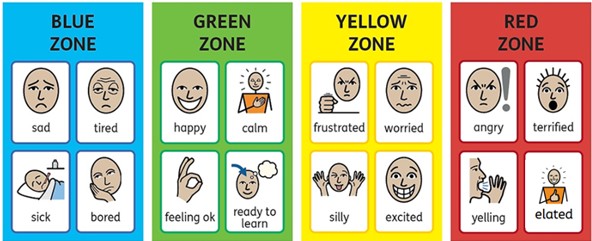
Zones of Regulation is a framework designed to help individuals, particularly children, develop self-regulation and emotional control. It categorizes feelings and states of alertness into four colour-coded zones:
Zones of Regulation and Autism
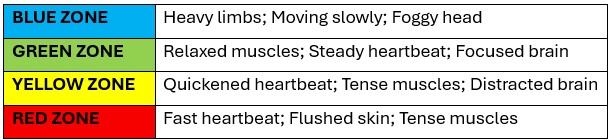
Individual with a diagnosis of Autism may experience alexithymia, which is the disconnect in identifying between an emotion and the physical feeling and can cause confusion in discerning what emotion is being felt. This is particularly true in respect of the red zone and distinguishing between the feelings of anger, fear and elation. It is, therefore, helpful to support individuals to recognise the different possible body signals common with the zones:
The Chalet School approach to Zones of Regulation
At The Chalet School, our goal is to teach pupils to recognise their emotions, understand how these might physically feel, and use strategies to move toward the Green Zone, where learning and social engagement are most effective.
Our pupils are reminded that there is no such thing as good or bad zones but, rather, they are a natural experience of emotions that everyone feels. We can move through different zones throughout the day or even the hour. What is important is to recognise our emotions and what we can do to help ourselves identify, communicate and manage them. By assisting and modelling through co-regulation, our staff support pupils to self-regulate and advocate for their emotions and needs.
Our key message is Acknowledge, Accept and Support.
How Zones of Regulation are embedded throughout The Chalet School
Zones of Regulation are integrated into daily routines in the following ways:
1. Visual Supports
Posters, charts, and personal cards help pupils identify their current zone. These visuals are placed throughout the school.
2. Accessible Resources
Each classroom has a sensory trolley complete with resources to support pupils to independently identify zones and self-regulate.
3. Explicit Teaching
Staff teach emotional vocabulary and coping strategies through structured PSHE lessons, social stories, and intensive interaction sessions.
4. Check-ins
Pupils start the day by identifying their zone using a chart and revisit this after transition times such as lunchtime. Regular check-ins allow staff to monitor emotional states and intervene early.
5. Sensory Circuits
Transition times, particularly the beginning and end of the school day, are supported with sensory circuit activities which encourage pupils to explore zones and self-regulate via physical activity:
- Blue Zone: Movement breaks, energizing activities.
- Yellow Zone: Calming techniques like stretching and deep breathing.
- Red Zone: Safe spaces, movement breaks, and adult support.
If you would like support with using Zones of Regulation at home, please contact your child’s class teacher.