
Curriculum overview
The Curriculum
At The Chalet School we believe that pupils should be able to dream big, believe in themselves and achieve their goals. We have designed our broad, balanced and knowledge-based curriculum to enable all pupils to develop a love of learning in which they can deepen their knowledge of existing interests and have the opportunity to gain new interests. We aim to recognise and break down barriers so that pupils enjoy a full and well-structured educational experience and develop their confidence and resilience.
Communication is key to enabling pupils to access the world around them in a meaningful way, and this sits at the very heart of The Chalet School curriculum giving pupils the tools to be able to engage with learning, express themselves in their own individual way and attend to others to build relationships. We recognise our pupils as individuals and plan a programme of learning for each pupil linked to their individual needs which complements their academic offer. We support all pupils to develop their independence from the moment they join The Chalet School and aspire for them to be well prepared to embrace their next phase of education at the end of their journey with us.
We value the outside spaces across the school site, including a school garden, woodland learning area and school pond, which enables pupils to find physical activity that they enjoy and helps them learn about the importance of a healthy diet and an active lifestyle. In addition, spacious playgrounds enable all pupils to learn ‘inside, outside and everywhere’.
Learning Cycle and Pedagogy
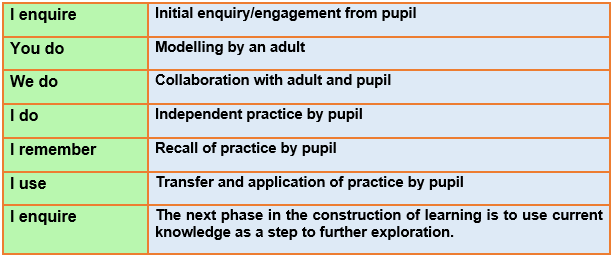
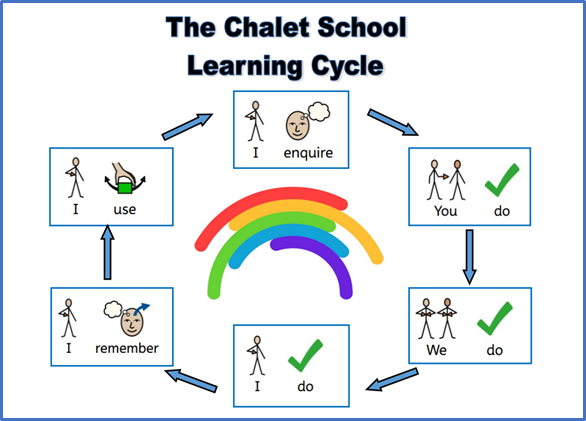
Pupils at The Chalet School receive a broad and balanced curriculum suited to their individual needs. Based on Piaget’s Constructivist Theory which expounds that learning should be constructed, active, reflective, collaborative, enquiry-based, and evolving, the Chalet approach places the pupil at the heart of the learning cycle and ensures that they are active participants in their development, rather than passive recipients of instruction. For children to fully explore and immerse themselves in the world around them, and to understand their place and identity within it, they require the appropriate supports and scaffolds from which they can grow into independent learners who are able to identify and advocate for their own needs. The key steps in this learning are as follows: